Designing a better loan experience to drive growth for small businesses and lenders
As the founding designer, I helped shape end-to-end design for a startup simplifying business funding. Working with leadership and engineering, I turned complex processes into simple, trusted experiences that drove product-led growth, brought in 30,000+ users, and strengthened business performance and credibility.
Company
Levr.ai
Headquarters
San Francisco, US
Industry
Fintech
Role
Senior Product Designer
Team
CEO, CTO, 2 Designers, 2 Developers

The project
Securing funding is a critical moment for small business owners, but the process is often confusing, time-consuming, and full of financial jargon. They were left feeling lost, while lenders faced incomplete or mismatched applications, leading to missed opportunities.
Levr.ai aimed to be the platform that removed this friction: helping businesses discover the right lenders, understand their options in plain language, and apply to multiple sources through a single, streamlined application. And in turn, help lenders receive complete applications.
Key achievements
As the founding designer, I worked on all aspects of design for a true zero-to-one build of Levr.ai, shaping product strategy, driving user research, and designing core experiences from scratch. I partnered closely with leadership, developers, and marketing to launch and continuously evolve the platform and internal processes.
Product roadmap
Defined the product direction based on insights from user interviews and market research, aligning business goals with user needs.
End-to-end product
Turned a complex process into a clear, confidence-building journey, supporting user growth while setting a strong foundation for product scalability.
Scalable design process
Built a flexible internal design process to support rapid iteration and ensure collaboration between design and development teams.
The outcome
My work helped Levr.ai grow to a $14M+ valuation by guiding small businesses through funding with clarity and delivering high-quality applications that brokers and lenders actively recommended, driving product adoption and company growth.
Company valuation
$14 Million
Users
30,000+
Review
"We now work exclusively in Levr.ai"
Product roadmap
As a venture-backed startup, we had to be laser-focused on building the right things at the right time. Balancing business milestones with real user needs, I kicked things off by deep-diving into the small-business lending space to map our best path forward.
Laying the groundwork: Research & Discovery
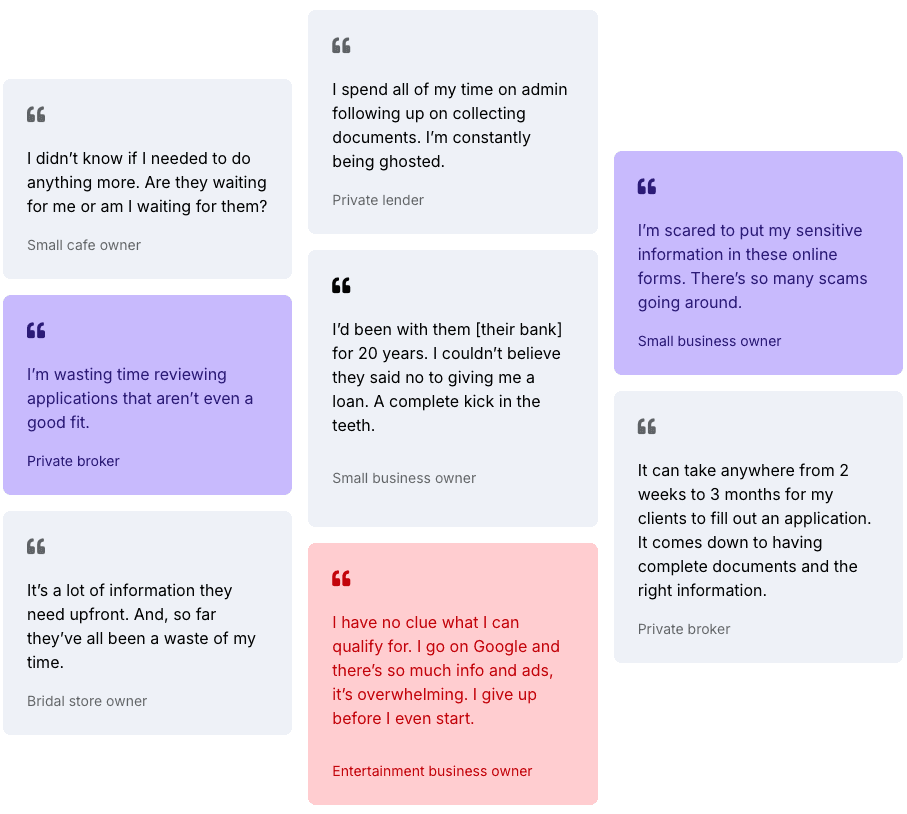
With a shoestring budget and very little time, I managed to conduct a competitor analysis and a handful of interviews with small businesses and private lenders. I uncovered the critical pain points on both sides of the lending process. This allowed me to identify key opportunities to streamline the experience for both parties. You can read more on how I do this in my article How I uncover customer insights that actually shape the product.
Business owners
Emotionally exhausted from multiple rejections, unclear on the process and requirements, and had security concerns around uploading sensitive data.
Brokers and lenders
Frustrated with incomplete and unqualified applications that wasted their time and potentially led to revenue loss.
A clear path forward: Determining the roadmap
Committed to a user-centered design philosophy I established a user journey that would guide the business owner through the process of exploring their options and confidently applying to lenders.
This led to three core features:
1. Onboarding & questionnaire: Simplifying the starting point.
2. Loan matchmaking: Connecting businesses to the right lenders, faster.
3. Unified application: One streamlined submission to reduce friction.
I brought these insights to leadership, and together we mapped a product direction that balanced user needs with investor expectations.
End-to-end product
The product evolved through an iterative, non-linear process. The three core features were built in tandem for an MVP in just six weeks, then continuously refined over the following year.
Establishing trust: Onboarding and questionnaire
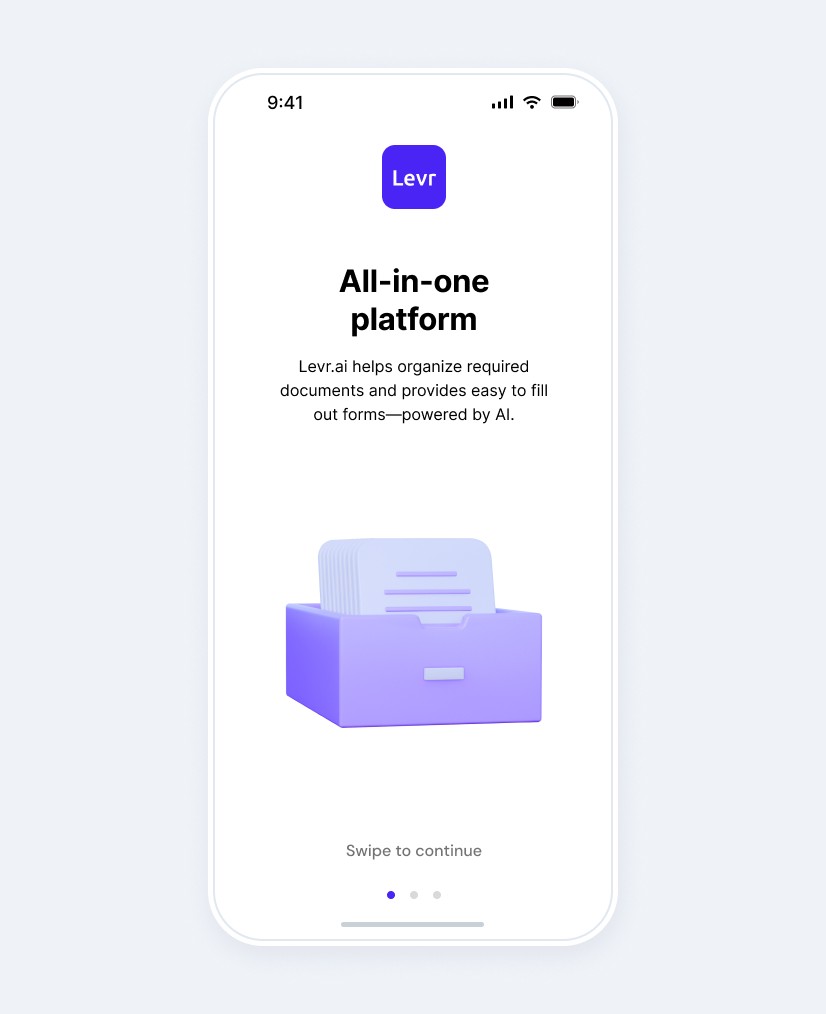
Onboarding and the questionnaire were the first touchpoint of our product for businesses, so it needed to be simple, clear, and build trust instantly.



Building confidence: Loan matchmaking
I started by asking: What would make reviewing loan matches feel clear, helpful, and even motivating? Drawing from user interviews, I brainstormed ways to reduce the typical overwhelm of comparing financial products and help business feel confident in their decisions.


Reducing friction: One application, multiple lenders
We set out to solve a major user pain: having to complete multiple, nearly identical applications for each lender. The vision was a single, unified application that could be sent to all selected lenders at once. We analyzed lender forms, identified common questions, and planned a dynamic experience that adjusted based on lender selection, asking for each piece of info only once, and only when needed.


Scalable design process
A clear, tailored design process was key to reducing errors and keeping delivery fast in our startup environment. By working closely with the team, we refined handoff, reviews, and documentation to fit how we worked best, and in return, saving time and improving outcomes for the company.
Cross-Functional handoff and review process
Collaborating for clarity and speed
A clear, tailored design process was key to reducing errors and keeping delivery fast in our startup environment. By working closely with the team, we refined handoff, reviews, and documentation to fit how we worked best, and in return, saving time and improving outcomes for the company.
Bringing checklists into Jira
One key improvement was embedding design documentation as actionable checklists within Jira tickets. This gave developers clear visibility into outstanding tasks and made progress more trackable, reducing ambiguity.
Changelog-style design updates
To manage mid-implementation tweaks, we introduced a changelog approach inspired by GitHub. I documented versioned updates directly in tickets, using timestamps and visual highlights to show exactly what had changed. This minimized confusion, missed updates, and unnecessary context-switching.
Changelog-style design updates
By approaching the dev team as users of the design process, we built a system that improved velocity, cut down back-and-forth, and fostered a more collaborative, product-focused culture.
The results
Onboarding and questionnaire
The redesigned onboarding balanced data collection with user comfort. A step-by-step flow, clear progress indicators, and trust signals made the process simple and approachable, with gamification elements that encouraged users without feeling patronizing.
Immediate impact:
✅ Completion rates jumped from ~30% to over 90%
✅ Time to complete dropped from ~16 minutes to just 2.5 minutes
Loan matchmaking
We found the final design delivered the right information at the right time. Familiar interaction patterns reduced friction, while clear visual hierarchy empowered users to make confident decisions.
Overwhelm turned to confidence:
✅ Most positively mentioned feature in further testing and surveys
✅ Users reported “feeling in control” of the loan process
✅ Increase in users moving from viewing matches to starting applications
Unified application
The redesigned application flow delivered results. By reducing friction and confusion, we saw a clear increase in completed applications and multi-lender submissions, meaning more small businesses secured loan offers, faster.
The streamlined experience also drove referral revenue, as more businesses applied through our platform. Lenders benefited too, with fewer incomplete applications and less back-and-forth, strengthening both partnerships and platform credibility.
The process became not just simpler, but more effective for the business owner, the lender, and for us.
A clear, tailored design process was key to reducing errors and keeping delivery fast in our startup environment. By working closely with the team, we refined handoff, reviews, and documentation to fit how we worked best, and in return, saving time and improving outcomes for the company.
Retrospective
Designing a zero-to-one fintech product taught me what building from scratch really means, shaping not just the UX, but the design process, team rituals, and product vision. I had to move fast, make clear decisions, and adapt within tight constraints.
The biggest impact came from collaboration. Working closely with developers and co-founders, I learned that great design is as much about alignment and iteration as it is about the user’s experience. I refined hand-off and communication to support engineering workflows, speeding up delivery and reducing friction.
Above all, I learned to stay focused on what matters: solutions that solve real user problems, drive growth, and scale with the business.
Recommendation
“Rhi’s super-power was definitely her exceptional ability to balance UX/UI priorities in tandem with the evolving needs of the product roadmap. She has an incredible understanding of the customer and used that insight to develop user-centric designs that make Levr.ai beautiful software to use. Her ability to recognize customer needs and translate it into products allows the team to learn and quickly optimize.”
Jennifer Daly
Marketing @ Levr.ai, Shopify, Malwarebytes